
Positions
Where you play someone matters. A lot. MFL uses a positional familiarity system that rewards you for putting players where they belong and punishes you when you don't.
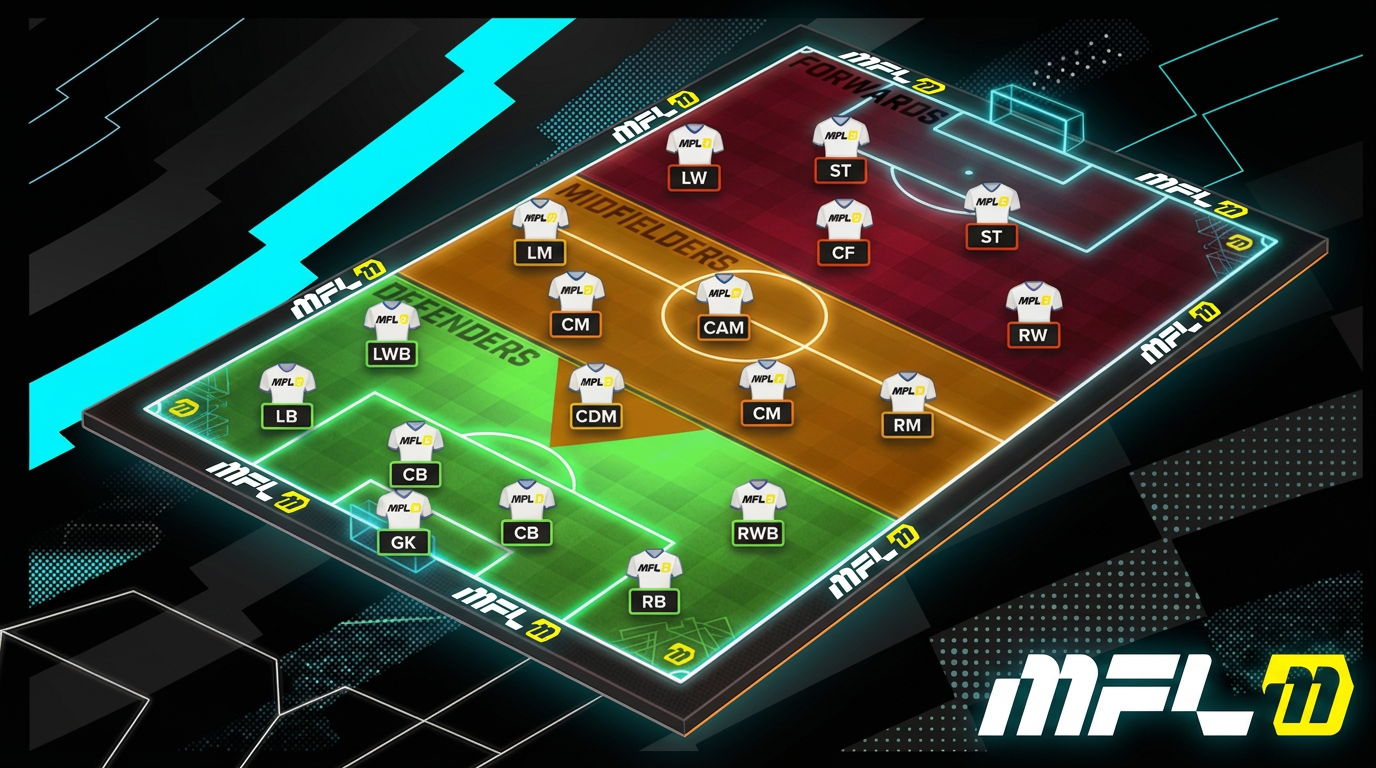
MFL Player positions on the pitch
Familiarity Levels
Every player has a primary position and up to two secondary positions. Beyond that, how comfortable they are depends on how close the role is to their primary position.
| Familiarity | Penalty to All Attributes |
|---|---|
| Primary | 0 (no penalty) |
| Secondary | -1 |
| Fairly Familiar | -5 |
| Somewhat Familiar | -8 |
| Unfamiliar | -20 |
A -20 penalty across the board on an Unfamiliar position is brutal. It can turn a Rare player into a Common-level performer. Don't do it unless you're truly desperate.
Key rule: Familiarity is based on proximity to the player's primary position only. Secondary positions do NOT extend the familiarity map.
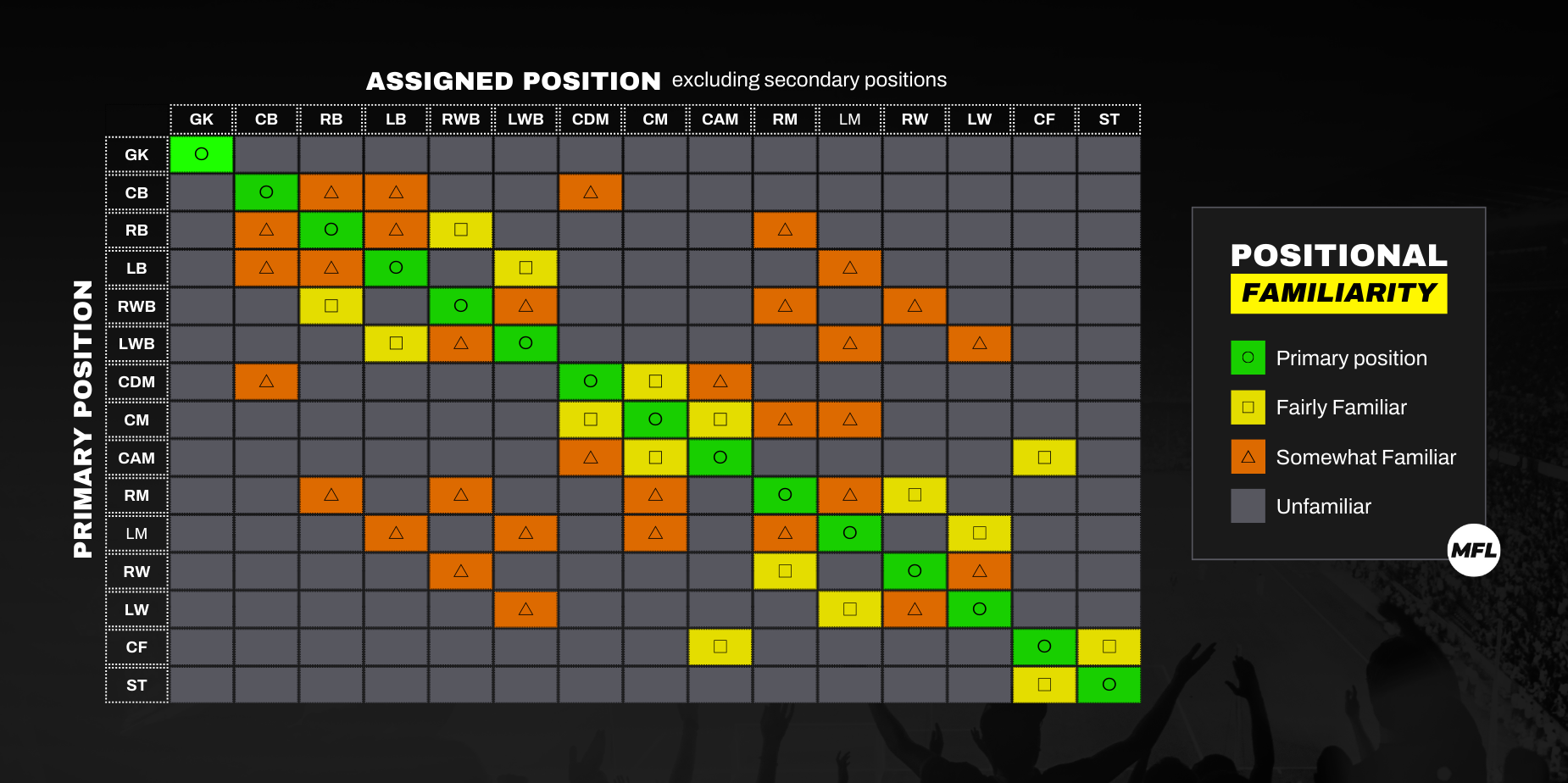
The positional familiarity matrix, based on a player's primary position.
Here's an example. Say you have a Right Winger (RW) with Right Back (RB) as a secondary position:
- RW -- Primary, no penalty
- RB -- Secondary, -1 penalty
- Positions near RW (like RM, CF) -- graded by proximity to RW
- CB, LB, LWB -- still graded by distance from RW, not from RB
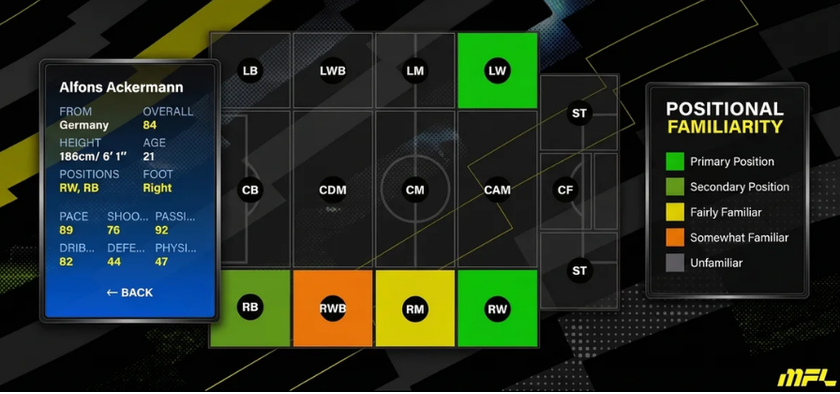
Having RB as a secondary doesn't make your player more familiar with other defensive positions. The familiarity radius always centers on the primary position.
Here's what that looks like in practice for Alfons, a Right Winger with Right Back as his secondary position. Even though his secondary position is RB, he doesn't get any advantage playing CB or LB.
Position Categories
| Abbr | Position |
|---|---|
| ST | Striker |
| LW | Left Winger |
| RW | Right Winger |
| CF | Center Forward |
Some players have a higher OVR when assigned one of their secondary positions rather than their primary. This happens because of how attribute weights differ by position. A player's raw stats might add up to a higher weighted average at a different position.
Because of positional familiarity, those players may or may not actually perform better in their secondary position (remember the -1 penalty). This phenomenon becomes more common as players progress and their ratings evolve.
Versatility is underrated. A player who can cover two or three roles at -1 or -5 gives you way more tactical flexibility than a specialist who crumbles the moment you move them one slot over. Especially valuable when suspensions or fatigue force you to rotate.